Recipe Index

It’s the hottest day of the summer so far. It’s so hot that the surface of the pool is turning warm, the first few inches as tepid as bathwater. She doesn’t have the energy to get up and dive into the cool depths of the deep end, but instead stretches out on a chair, her entire body limp from the heat. She can almost feel the sunburn prickling across her skin. Later that night, she’ll step into the outdoor shower and gasp when the water hits her back, as sharp as needles against the angry pink flush of her shoulders where she was too lazy to reapply sunscreen more than twice.

The air is cool, the heat of the day diffusing into the canopy of trees overhead. A breeze drifts in from off the river, ruffling the leaves of the quaking aspen that ring the campsite. Jack is stomping through the low bushes in the distance, his arms full of sticks for kindling. He drops the pile next to the fire pit and brushes the dirt from his shorts. His t-shirt is a soft faded navy with the words CHARLIE DON’T SURF emblazoned across the back. (Because she’s never been a fifteen year old boy, she doesn’t get the reference to Apocalypse Now.)

The market is part farmstand and part gourmet food store: a classic Hamptons dichotomy. The low-slung building is white and pretty, with a forest green awning on one end and large white cotton umbrellas standing sentinel over the picnic tables out front. Inside, strands of tiny globe lights criss-cross from the wooden rafters. The cool cement floor is painted a dusty moss green. Tables hold baskets of produce: shiny purple fairytale eggplant the size of your thumb, knobby heirloom tomatoes striped red and orange, bunches of carrots—still streaked with dirt from the ground—propped up at jaunty angles.
It’s the hottest day of the summer so far. It’s so hot that the surface of the pool is turning warm, the first few inches as tepid as bathwater. She doesn’t have the energy to get up and dive into the cool depths of the deep end, but instead stretches out on a chair, her entire body limp from the heat. She can almost feel the sunburn prickling across her skin. Later that night, she’ll step into the outdoor shower and gasp when the water hits her back, as sharp as needles against the angry pink flush of her shoulders where she was too lazy to reapply sunscreen more than twice.
The air is cool, the heat of the day diffusing into the canopy of trees overhead. A breeze drifts in from off the river, ruffling the leaves of the quaking aspen that ring the campsite. Jack is stomping through the low bushes in the distance, his arms full of sticks for kindling. He drops the pile next to the fire pit and brushes the dirt from his shorts. His t-shirt is a soft faded navy with the words CHARLIE DON’T SURF emblazoned across the back. (Because she’s never been a fifteen year old boy, she doesn’t get the reference to Apocalypse Now.)
It’s only 10 AM when she gets back to the apartment, but there’s music coming from the end of the hallway. It’s Martha and the Vandellas, which means Hadley’s in a particularly good mood, because Motown is her happy music (followed by reggaeton and anything by the Rolling Stones). She drops her keys with a clang in the glazed ceramic Astier de Villatte bowl that sits on their entryway table and sits down on the rattan bench to untie her shoes and peel off her socks.

The sun is watery but strong, filtering down through the canopy of dogwoods that marks the boundary between their lawn and the neighbors’. She sets her laptop down carefully on the patio table. A bowl of sliced plums, ice cold and just on the firm side of ripe, sits next to a glass of fizzy salted lemonade. The lemonade is something she picked up in college: Her sophomore year roommate in college had been dating a chemical engineer named Atid who’d grown up in Thailand.

On their fourth date, he tells her about his ex-girlfriend, a woman named Marisa Donicio who now runs a winery in Sonoma. This doesn’t bother her as much as she thought it would, and she finds herself happy to listen as he describes the way Marisa used to floss her teeth in the middle of a movie, a sign he describes as a red flag so flagrant that it appears crimson in hindsight.
The television is on with the volume muted in the waiting room. She tries to avoid looking at it, concentrating instead on the magazine in her lap — a back issue of the New Yorker open to an article on tracking musk oxen in the Alaskan wilderness — but the persistent neon flashing proves impossible to ignore.
She sighs, and sets the magazine aside, folding one leg up underneath the other and adjusting her weight in the overstuffed chair. The news anchor’s million-watt smile fills the screen, just above the ticker tape of breaking updates scrolling slowly at the bottom of the frame. All anyone is talking about is the storm: up to 19 inches predicted for Pembroke, 24 for downtown Boston, and Sharon forecast to be inundated with almost 30.

Her nerves feel as tangled up as a knotted shoelace, needing to be gently teased apart and smoothed. Jangled, that’s the word for it. The nerves—electric and snarled—are covering up other things: the persistent pulse of worry and the melancholy blue tinge of sadness and possibly even a fiery, flaming red anger, but she hasn’t dug down that far yet, unable to even touch the top layer.

The floor in her bedroom is made of wide wooden planks. The apartment is on the 8th floor of an imposing limestone building on the corner of Commonwealth Avenue, a stone’s throw from the Boston Public Garden. Pale-colored brick covers part of the faded facade—this is a building that whispers old money and summers on Nantucket and Harvard alumni. Inside, the lobby reminds her of an aging patrician matriarch: once beautiful and still formidable, but time-worn and washed out. The walls are mirrored and an ancient green carpet directs visitors around a massive oak table upon which sits a flower arrangement so large you can barely see the doorman in his navy blazer. He sits at a marble-topped desk, the polished brass buttons dotting his lapel a perfect complement to the brass trimming along the wainscoting. Wainscoting: this was one of many words she’d never spoken aloud, or knew of, before she moved into apartment 8F. Part of her education is living in the rarified sphere of wealth of the Carlton House (she didn’t know apartment buildings could have names that sounded like prep school dormitories); part of it is Hadley.

Working at a start-up is exhausting—that’s how she puts it to everyone who asks whenever she travels home to the suburb where she grew up. Regardless of how unglamorous the reality, her parents' friends look impressed when they find out she’s living in the city, employed at a company that’s frequently cited in Forbes and Business Insider: a “hot” place to be, as her father’s friend Everett puts it. He tilts his old-fashioned at her, the ice rattling around the almost empty glass. Everett’s words are a little slurred as he says, “You’re in exactly the right place! Good for you for getting that pedigree. You got a head on your shoulders!” He nearly shouts the last bit, and she leans back to avoid any errant splashes of bourbon. Before she can respond, he’s shaking the glass in the direction of his wife, who’s wearing the exact same outfit she wears to every social function—regardless of the season or occasion: maroon tweed skirt, white turtleneck, black cashmere cardigan with a lizard-shaped brooch. Two tiny emeralds wink as the lizard’s eyes; when she was little, the brooch terrified her, keeping her from falling asleep some nights.

Hi, hey, a note: Thank you for your thoughts on my last post! Haven’t decided for or against the newsletter yet, so for now, we’ll just carry on with some occasional fiction here, and who knows what else, and we’ll see where life takes us…
She feels deflated—and tired of talking—when she walks into the coffee shop on Wednesday morning. The argument last night with her mother sticks to her, and she can’t shake the off-kilter feeling. She and her mother never fight; in their household, it’s her dad whose hot temper sparks the arguments. She and her siblings were always arguing with him in a comfortable, this-is-how-we-love sort of way: One minute they were shouting and slamming doors, and then by dinner time everyone was completely fine. Fights with her dad pass like a quick thunderstorm, the tension dissolving into nothingness, the chaos necessary to clear the air—just like weather.
It’s only 10 AM when she gets back to the apartment, but there’s music coming from the end of the hallway. It’s Martha and the Vandellas, which means Hadley’s in a particularly good mood, because Motown is her happy music (followed by reggaeton and anything by the Rolling Stones). She drops her keys with a clang in the glazed ceramic Astier de Villatte bowl that sits on their entryway table and sits down on the rattan bench to untie her shoes and peel off her socks.
The sun is watery but strong, filtering down through the canopy of dogwoods that marks the boundary between their lawn and the neighbors’. She sets her laptop down carefully on the patio table. A bowl of sliced plums, ice cold and just on the firm side of ripe, sits next to a glass of fizzy salted lemonade. The lemonade is something she picked up in college: Her sophomore year roommate in college had been dating a chemical engineer named Atid who’d grown up in Thailand.

The first time the phone rings, she doesn’t hear it.
The second time it rings, she picks it up on the third ring and says breathlessly, “What happened?”
His voice comes across the line, deep and happy, and she can picture him smiling as he answers. “It worked! We’re celebrating. If, that is, you’re free.”
She glances out of the window where the snow is falling thick and fast, the flakes so fat and heavy it’s as if they can barely stay aloft. The afternoon is tilting rapidly towards dusk, and the curtain of snow obscuring the city only serves to hasten the departure of daylight.

The farm stand is situated just off the side of the road—tucked behind a beautiful old farmhouse with a wraparound porch. The stand itself is a ramshackle wooden building that’s open in the front and on both sides so that people can wander around the tables full of pumpkins and lean down to pick up an apple from the bushel baskets lining the pathway. A strong gust of wind could probably blow the whole thing over, she thinks, but then reconsiders—this very structure has likely withstood the force of generations of Maine winters, weathering the snow and ice with its steadfast, stoic presence.

“Okay,” she says slowly. “I’ll think about it,” and she hangs up the phone, holding it in her hand and staring at it as if some message will appear on its darkened surface like a Magic 8-Ball. She and her sister used to consult the Magic 8-Ball religiously when they were younger: There was a phase, somewhere around age 13, when they genuinely believed it told you true things. This was the era of sleepovers and Ouija boards and middle school mixers where all of the girls stood in a knot on the polished floor of the gym and the boys threw cheese puffs at each other by the folding tables that held the sodas.

Things that make me feel more like myself:
The smell of wood smoke in early fall
Thinking about books I loved when I was little (the Betsy-Tacy series, the Mennyms, Mrs. Piggle-Wiggle, The Hobbit)
Arguments (the right kind)
Music I listened to in high school and still do (Indigo Girls, Simon & Garfunkel, The Beach Boys)

On very foggy mornings, he rolls over and murmurs sleepily to her, “We’re inside a cloud!” before closing his eyes again. Fog rolls in often on the coastline, blanketing the ocean and horizon beyond, leaving the clapboard houses to the left and right of theirs awash in a delicate mist. Humid mornings, especially before or after rain, are a study in grays: dove gray clouds, silvery gray drizzle, curtains of pewter condensation obscuring the hydrangea bushes that have been aching to burst into bloom all spring and are now reveling in their seasonal riot of color.

Before dinner but after my shower the other night, when the sun hadn’t begun to set but the heat outside was starting to loosen its grip on the day, I put on pajamas and lay flat on my back on the bedroom floor. I didn’t move for minutes. I just stared up through the picture windows and noticed a plane—its tiny wings looking toy-like from a distance.
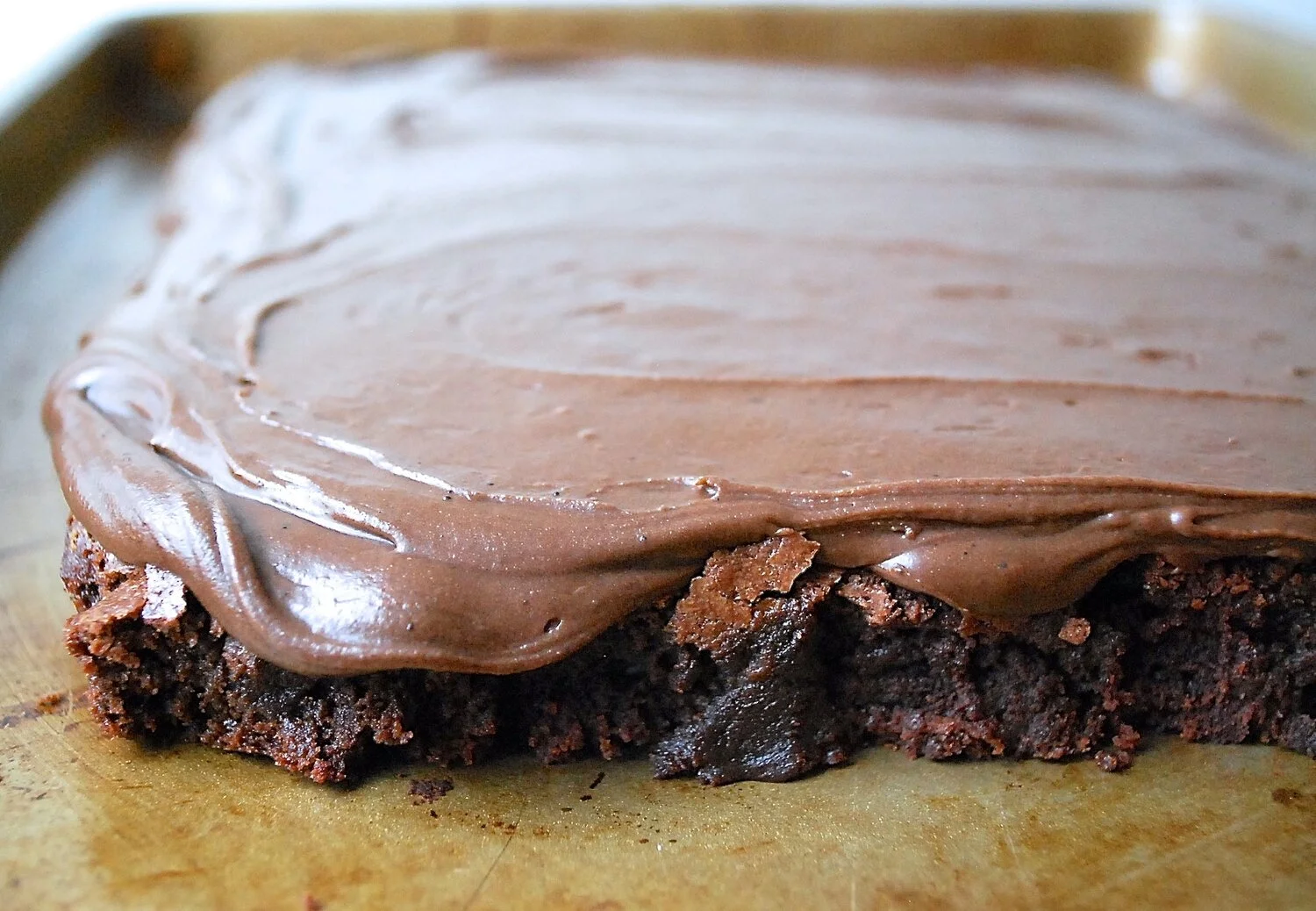
Let’s talk about frosting for a minute. While it’s not as controversial a hot-button topic as, say, the student debt crisis or universal health care, it does seem to elicit strong opinions. And look, I like frosting! A lot! I also attempt to maintain a modicum of restraint when faced with it, because unlike when you’re a kid, it turns out that it’s not entirely appropriate for a self-respecting adult to come to blows over the piece of cake with the most frosting. (I think this is in the “How to Comport Yourself Maturely and Act Your Age Handbook” which I cannot place for the life of me! I’m sure it’s on my bookshelf somewhere. Pretty sure. It must be.)

A year and three days ago, almost to the hour, I stood in the kitchen of our New York City apartment and thought about lunch. It was sunny outside, but cold, and I didn’t want to try and stretch the zipper of my down jacket over my very pregnant stomach. My husband typed away at his hastily built standing desk on the marble island. He’d been planning to start two weeks of paternity leave once I gave birth, but of course life loves a good PLOT TWIST, and here’s a good one for you: Five days earlier, he came home from work complaining of a stomachache that increased rapidly in severity, until he swore he had to go to the ER. I stayed home, heavily pregnant and silently (okay not so silently) cursing him for taking the risk of walking into a hospital waiting room with this confusing, nebulous threat of a virus hanging over us. People were just starting to throw around the words pandemic and quarantine.

The cookie crumbled slightly under her touch, leaving a spray of dust across the table between them. Adam picked up a second one from the plate, turning it around in his hand. It was thin and flat and as wide as his broad hand with the crinkled look of a very good molasses cookie. It was chewy and crisp at the same time—the slip of paper under the plate read simply miso, brown butter, rice flour. The other lines were equally intriguing: graham flour, rum, thyme and candied fennel, tahini, caramel.

The breakfast room is bright; sunlight streams in through the palladian windows. The air smells of bacon and coffee and the subtle saltiness of sea air drifting in from off the sound. A platter of croissants and slices of lightly toasted Portuguese bread sits on the center of the table, flanked by delicate Royal Delft dishes holding softened butter, marmalade, and beach plum jam. Will saunters in, his hair tousled and his shirt rumpled, testament to the late hour he stumbled home the night before. Despite the gorgeous day unfolding and the leisurely breakfast awaiting them, there’s tension humming in the room.

SIX YEARS AGO
“All it does is rain here,” she says gloomily. She kicks at the leg of a wicker chaise lounge and it collapses, flipping onto its side. “This entire house is falling apart. It’s crap.”
“What’s got you in such a foul mood?” Whit asks through a mouthful of cereal.
“That’s repulsive, Whit,” she says. He’s just poured himself a bowl of Honey Bunches of Oats and doused it with a stream of heavy cream until the cereal almost disappeared. “You might as well eat a stick of butter for breakfast.”
The market is part farmstand and part gourmet food store: a classic Hamptons dichotomy. The low-slung building is white and pretty, with a forest green awning on one end and large white cotton umbrellas standing sentinel over the picnic tables out front. Inside, strands of tiny globe lights criss-cross from the wooden rafters. The cool cement floor is painted a dusty moss green. Tables hold baskets of produce: shiny purple fairytale eggplant the size of your thumb, knobby heirloom tomatoes striped red and orange, bunches of carrots—still streaked with dirt from the ground—propped up at jaunty angles.
It’s only 10 AM when she gets back to the apartment, but there’s music coming from the end of the hallway. It’s Martha and the Vandellas, which means Hadley’s in a particularly good mood, because Motown is her happy music (followed by reggaeton and anything by the Rolling Stones). She drops her keys with a clang in the glazed ceramic Astier de Villatte bowl that sits on their entryway table and sits down on the rattan bench to untie her shoes and peel off her socks.

Today she’s eating lunch. Tuna salad again. The breeze is riffling the tops of the trees. Two yards over, the neighbors are painting. Steve, the husband, leans a ladder against the side of the house and it sways and clanks menacingly.
She takes another bite, chewing slowly, and watches out of the corner of her eye as Steve bends over to pick up a paintbrush, then straightens. Steve is a salt-of-the-earth type. He grew up in Harwich, out on the Cape, where his dad ran a boat repair shop and his mom raised him along with three brothers: rowdy, ruddy-cheeked boys who all settled nearby after high school and immediately set about having children. Sometimes they come to visit. She’s met them all separately but still can’t tell them apart in their sameness. They’re all broad-shouldered, with the weatherbeaten skin of someone who grew up on the water.
The sun is watery but strong, filtering down through the canopy of dogwoods that marks the boundary between their lawn and the neighbors’. She sets her laptop down carefully on the patio table. A bowl of sliced plums, ice cold and just on the firm side of ripe, sits next to a glass of fizzy salted lemonade. The lemonade is something she picked up in college: Her sophomore year roommate in college had been dating a chemical engineer named Atid who’d grown up in Thailand.

There are so many different ways to be homesick, she’s discovering. There’s the obvious kind: the textbook definition where you miss your parents and your home This is the kind she felt when she was 12 and spent three weeks at Camp Watama on Lake Wentworth in New Hampshire. Her tentmate was a girl named Cammy Mason from Short Hills who wore sparkly eyeshadow and liked to brag about how she had already watched Dirty Dancing with her older sister’s friends. Cammy’s brash confidence made her feel small and inexperienced and homesick for her two best friends still preferred to play board games and watch old episodes of I Dream of Jeannie when they had sleepovers.

She waits for a long, slow second. It stretches like taffy into another second, then another, until nearly half a minute has elapsed. The silence becomes so meaningful that she can picture it like expanding like a balloon, taking on more air as it swells uncomfortably.
“Okay,” she says stiffly, the word coming out crisp and business-like: the verbal equivalent of rapping sharply on the top of a creme brulee, cracking the sweet candy coating around her heart.
“It’s not…I’m sorry. I tried but I can’t change it,” he stumbles over his words but rather than sounding apologetic, he sounds impatient, like he’s placating a child and wishes to be done with it.
The first time the phone rings, she doesn’t hear it.
The second time it rings, she picks it up on the third ring and says breathlessly, “What happened?”
His voice comes across the line, deep and happy, and she can picture him smiling as he answers. “It worked! We’re celebrating. If, that is, you’re free.”
She glances out of the window where the snow is falling thick and fast, the flakes so fat and heavy it’s as if they can barely stay aloft. The afternoon is tilting rapidly towards dusk, and the curtain of snow obscuring the city only serves to hasten the departure of daylight.
The breakfast room is bright; sunlight streams in through the palladian windows. The air smells of bacon and coffee and the subtle saltiness of sea air drifting in from off the sound. A platter of croissants and slices of lightly toasted Portuguese bread sits on the center of the table, flanked by delicate Royal Delft dishes holding softened butter, marmalade, and beach plum jam. Will saunters in, his hair tousled and his shirt rumpled, testament to the late hour he stumbled home the night before. Despite the gorgeous day unfolding and the leisurely breakfast awaiting them, there’s tension humming in the room.
The farm stand is situated just off the side of the road—tucked behind a beautiful old farmhouse with a wraparound porch. The stand itself is a ramshackle wooden building that’s open in the front and on both sides so that people can wander around the tables full of pumpkins and lean down to pick up an apple from the bushel baskets lining the pathway. A strong gust of wind could probably blow the whole thing over, she thinks, but then reconsiders—this very structure has likely withstood the force of generations of Maine winters, weathering the snow and ice with its steadfast, stoic presence.

She cranes her neck, stopping so abruptly in front of a Barnes & Noble that a man in a sharply tailored navy suit and camel coat walking briskly behind her almost steps on the heels of her ballet flats (cerise suede from J.Crew, a pair she ogled for weeks in the window of the Fifth Avenue store before finally buying).
“Anna!” she hisses, grabbing her sister by the arm. “Stop, stop!” Her sister stops and looks around. “What? We’re still two blocks away, I just checked.”
A year and three days ago, almost to the hour, I stood in the kitchen of our New York City apartment and thought about lunch. It was sunny outside, but cold, and I didn’t want to try and stretch the zipper of my down jacket over my very pregnant stomach. My husband typed away at his hastily built standing desk on the marble island. He’d been planning to start two weeks of paternity leave once I gave birth, but of course life loves a good PLOT TWIST, and here’s a good one for you: Five days earlier, he came home from work complaining of a stomachache that increased rapidly in severity, until he swore he had to go to the ER. I stayed home, heavily pregnant and silently (okay not so silently) cursing him for taking the risk of walking into a hospital waiting room with this confusing, nebulous threat of a virus hanging over us. People were just starting to throw around the words pandemic and quarantine.

Heavy rainfall three days ago melted the heaps of snow that had piled up against the boxwoods in front of the house. Once the clouds cleared, the sun appeared against a sky painted all lustrous, sheer blue—ice on the roof dripped in slow, languid trickles down the kitchen windows. The intervening days have been cold but sunny: they feel like spring, like I’m stepping outside into the words green and fresh.

I have a trick I use when I’m sad or scared or anxious. (Actually, I hesitate to call it a “trick” because it comes to me entirely unbidden—I don’t perform it as an exercise, but I slip into it reflexively and without intention.)
Here’s what I do: I imagine myself inside a children’s book. Not just any book though: the sort that has a little town in it, beautifully rendered in images. There’s a library, full of shelves of books in jewel tones, and a friendly librarian who peeks over her half-moon glasses at you. There’s a candy shop with glass jars of brightly colored gumdrops and jumbo swirled lollipops and baskets of taffy twisted up in waxy pastel paper.

Here’s how I used to make scrambled eggs: Crack eggs carefully into a mini blender with a tiny bit of olive oil. Add a pinch of sea salt. Blend on high until frothy. Melt butter in a nonstick skillet before pouring in the eggs. Cook on very low heat, stirring constantly, until creamy and just barely set. Don’t worry about the fact that it takes you 15 minutes to babysit your eggs because girl, you’ve got time! Relax!
Here’s how I make them now: Start to melt butter in pan. Crack egg directly into pan with one hand before butter is even warm while unloading dishwasher with other hand. Stir furiously over high heat. Flip eggs out into a bowl a minute later. (Spoiler alert: They are basically as good this way as the first method.)

Actor Hugh Laurie (yes, he of the sardonic British wit and House acting fame, although I know and love him best for his role in Jeeves and Wooster) apparently put out a blues album a few years ago. Who knew he had such versatility?! We all contain multitudes, as it turns out. Upon being asked why he went out on such a limb, career-wise, he said this: “It’s a terrible thing, I think, in life to wait until you’re ready. I have this feeling now that actually no one is ever ready to do anything. There is almost no such thing as ready. There is only now. And you may as well do it now. Generally speaking, now is as good a time as any.”

One of the books that really affected me in high school was Annie Dillard’s Pilgrim at Tinker Creek. I’ve since reread pieces of it and it surprises me how intense it is: violent and brash and deeply spiritual in a way that almost feels dark. But I can still understand why it moved me so—not unlike many formative experiences around that age, it was the newness of it, the way it simultaneously cracked open my world to become wider and spoke to something deeply familiar within me.

Here I am, sitting outside with a mug of tea, wrapped in a blanket and stubbornly refusing to accept the fact that it is straight up cold outside. I showed up at 7:15 this morning for the “Dirty 30” circuit workout class, held in the parking lot outside of the trainer I occasionally visit. (Yes, it is AS FIERCE as it sounds. My muscles currently feel like jelly.) Katie—the trainer—runs small group classes, which are wicked hard combination of kettlebells and TRX and core and crossfit and medicine ball slams and sprints and more varieties of squat jumps than I realized existed. She’s been running classes outside all summer—and soon it’ll be too cold to carry on like this. Like so much else in the world, we’ll just have to see what happens next.

“Why did you leave?” His voice is low and calm. She’s quiet for a few moments, searching for the right words. “If I’m being honest, I was afraid to stay,” she hesitates for a moment before continuing. “Sticking with things I might not be good at isn’t exactly my strong suit.” Saying the words out loud feels like plunging into a pool of dark, freezing cold water.
Her siblings rib her endlessly about her competitive streak—it’s funny and tender-hearted coming from them, but the truth of it pierces her nonetheless every time. She knows that a sharp, merciless streak runs through her core, like a bright silver ribbon.

They pull over and park on the side of a dusty, dirt- and gravel-packed road alongside the river, where it curves lazily under a covered bridge and disappears away in the distance like a silver coil. Above them, one hot air balloon rises in the dusky late-evening sunshine, then two, then three. Within twenty minutes, the entire sky is filled with them. The one closest to them is a patchwork of canary yellow and bright red squares. She watches it rise, pausing to sneak a quick sideways glance at him—just as rapt— then turns back to witness the continued ascent. His hand, broad and calloused, brushes against hers and her heart seems to mirror the ballon: so light and full it might burst out of her chest.
Summer, she thinks. Summer is the best time with him.
Yesterday, a friend wrote me to say he was moving back to the east coast after a few years in Los Angeles. I asked why, and he responded: “Loneliness? And I miss the seasons.” I can easily imagine feeling both emotions keenly if I moved somewhere far-away and warm. I know he meant them as separate items (loneliness for a happy clan of close friends who live back east and dreaming of the physical passing of seasons)—but to me, they’d be one and the same.

My phone buzzes with a message from my mom—she’s sending me an article by Leandra Cohen in her Substack newsletter. It was sent to her by a friend (hi Zoe!), who is the sort of person whom you’d want on a hiking trip with you for hours of conversation: funny and thoughtful and curious about everything. Leandra’s piece is written as a letter to her daughters. In it she writes: “I had been thinking that here, on the occasion of your first birthday, I had this chance to sensationalize how profound and electrifying and intense it had been to be your mom. And it was all those things! It is. But it has also been remarkably tedious and frustrating and boring and at times, even soul-crushing. This has shown me something significant.”

None of my sisters were particularly picky eaters as children, nor was I. My oldest sister would get a stomachache when she ate any airy desserts—whipped cream, mousse, and so on—but that was pretty much the extent of our “will not eat” list. None of us had allergies, and instead of memories of what we wouldn’t eat, I remember most keenly what each of us liked best. Two of us loved the creamed onions at Thanksgiving, the tiny pearl orbs coated in a buttery sauce. One of us like to eat slices of untoasted white bread slathered with bright yellow mustard for breakfast on the way to school. We all liked calzones, homemade graham crackers, and broccoli in almost any form.

Guys, it is beautiful outside today. Beautiful! This time of year is marked by the most stunning sunrises—the sky streaked and splashed with colors that call to mind words like apricot and persimmon. In contrast, the sunsets are muted and calm, the tops of the trees bathed in straw-colored light as the surface of the water just beyond our street reflects the sky above: all soft cotton candy pinks and delicate lilacs.

Yesterday I saw the first sailboat of the season. From a distance, the white triangle of its sail appeared against the bright blue of the sky; I stood watching, my heart picking up its happy rhythm, as the polished hull emerged into the mouth of the bay, moving slowly through the channel where the land narrows at the entrance to the town marina. The white sail looked so jaunty and cheerful: waving and flapping lightly as the ropes clanked and thwacked against the mast. After the dark, cold winter (METAPHORICALLY AND LITERALLY OBVIOUSLY), it seemed to be beckoning to us, calling out “Hello bright things! Picnics ahead! Sunny days and mint lemonade and bike rides in the warm evenings!”.

Much like all of you, my mind is swirling with a lot lately. As I sit here, in my bright little house on this quiet little street perched on the edge of a bay that gives way to the wide expanse of ocean beyond, it occurs to me once again what a strange juxtaposition this year (and this era) has been—more than ever, we’re all cocooned in, and anchored to, our own tiny individual orbits. And yet we’re so connected—digitally—to the world at large that it almost feels like we’re all sitting in a room together, shoulder to shoulder, watching each news story unfold live and in person right in front of us, turning to each other to commentate and opine and speculate.

We drive at a breakneck speed in an open-air taxi around winding roads that climb higher and higher away from the marina that sits at sea level. The air is hot and heavy, as if it carries more weight here than back at home, freighted with the scent of salt water and coconut and something spicy but citrusy. We pass Cinnamon Bay and I clutch at the edge of the taxi’s door frame, sure that we’re going to drop right off the sheer face of the cliff to our left every time a truck comes whooshing past us without slowing down.

So much of the first two decades of life is a constant switching of gears. I think about high school: 50 minutes of class followed by a rush to get to the next one. A swirl of girls in royal blue skirts and white polos spilling out into the wide hallways, a cacophony of metal locker doors banging shut and shrieking laughter and shoes slapping on slick red-and-white vinyl tile—then repeat, repeat, repeat until a hurried lunch and more classes—my mind spinning rapidly from the finer points of the defenestration of Prague in AP European History, to a sight reading of the first three lines of Vergil’s Aeneid Book 2 in the original Latin, to a tightly-scrawled page of notes on differential calculus equations. In the back of it all, I’m thinking about field hockey practice and hitting my drive harder on the jewel-green turf and what shirt to wear on Friday night and how a yet-unnamed boy’s hair looks when he flips the shiny flop of it off his face with a flick of his head.

The sky overhead is awash in pastel colors, as if someone had taken to it with a paintbrush and over-enthusiastically daubed on broad watery brushstrokes.
This is her absolute favorite time of day: just after a sweaty run and a shower, but before cocktails or dinner, when the entire world seems to be taking a breath before nightfall. It’s not dusk that she loves, but the minutes just before it, when the sun is considering its descent but hasn’t begun, when the day is on the precipice of turning off the light but remains bright.
“Why did you leave?” His voice is low and calm. She’s quiet for a few moments, searching for the right words. “If I’m being honest, I was afraid to stay,” she hesitates for a moment before continuing. “Sticking with things I might not be good at isn’t exactly my strong suit.” Saying the words out loud feels like plunging into a pool of dark, freezing cold water.
Her siblings rib her endlessly about her competitive streak—it’s funny and tender-hearted coming from them, but the truth of it pierces her nonetheless every time. She knows that a sharp, merciless streak runs through her core, like a bright silver ribbon.
Yesterday, a friend wrote me to say he was moving back to the east coast after a few years in Los Angeles. I asked why, and he responded: “Loneliness? And I miss the seasons.” I can easily imagine feeling both emotions keenly if I moved somewhere far-away and warm. I know he meant them as separate items (loneliness for a happy clan of close friends who live back east and dreaming of the physical passing of seasons)—but to me, they’d be one and the same.

I reached for a new tube of toothpaste earlier this evening (Colgate Total, if you must know.) As I stood in front of the mirror, idly pretending to wait the recommended 30 seconds before the electric toothbrush beeps, letting you know you’re mastering your dental hygiene and may move from the top to bottom teeth, the flavor of it walloped me. It was minty, like all toothpastes (unless you’re five and brushing with Tom’s of Maine Silly Strawberry, as one does)—but a very specific sort.

As someone who doesn’t much adhere to the habit of a conventional breakfast (by which I mean eating a meal first thing in the morning), I do love breakfast foods. I see no reason why something as good as a perfectly cooked omelette should be relegated to the wee hours of the morning only. The French seem to have this right—bistro menus often feature an omelette (fluffy and yellow, rolled into a fat cylinder, without a speck of browning on the surface) oozing Gruyere cheese, dotted with fines herbes, and accompanied by a tangle of lightly dressed greens and a glass of white wine.
My phone buzzes with a message from my mom—she’s sending me an article by Leandra Cohen in her Substack newsletter. It was sent to her by a friend (hi Zoe!), who is the sort of person whom you’d want on a hiking trip with you for hours of conversation: funny and thoughtful and curious about everything. Leandra’s piece is written as a letter to her daughters. In it she writes: “I had been thinking that here, on the occasion of your first birthday, I had this chance to sensationalize how profound and electrifying and intense it had been to be your mom. And it was all those things! It is. But it has also been remarkably tedious and frustrating and boring and at times, even soul-crushing. This has shown me something significant.”
None of my sisters were particularly picky eaters as children, nor was I. My oldest sister would get a stomachache when she ate any airy desserts—whipped cream, mousse, and so on—but that was pretty much the extent of our “will not eat” list. None of us had allergies, and instead of memories of what we wouldn’t eat, I remember most keenly what each of us liked best. Two of us loved the creamed onions at Thanksgiving, the tiny pearl orbs coated in a buttery sauce. One of us like to eat slices of untoasted white bread slathered with bright yellow mustard for breakfast on the way to school. We all liked calzones, homemade graham crackers, and broccoli in almost any form.
Guys, it is beautiful outside today. Beautiful! This time of year is marked by the most stunning sunrises—the sky streaked and splashed with colors that call to mind words like apricot and persimmon. In contrast, the sunsets are muted and calm, the tops of the trees bathed in straw-colored light as the surface of the water just beyond our street reflects the sky above: all soft cotton candy pinks and delicate lilacs.

Much of what makes life life—something about which people want to write songs and pen novels; something full of joy and shivers of unexpected (and expected) pleasure—lies in watching how easily you can transform ordinary things into more.
Taking disparate elements and making them more than the sum of their parts happens all over the place. Take, for example, poetry. How many times have you said or used the words “vacuum cleaner” or “UPS driver” or “house” or “thief” — but then someone (in this case the poet Ron Carlson) puts them next to each other in this very specific order and suddenly they mean something bigger and so sweeping that you read them again and again, saving them in your notes to remember to write about right here, to all of you:
Much like all of you, my mind is swirling with a lot lately. As I sit here, in my bright little house on this quiet little street perched on the edge of a bay that gives way to the wide expanse of ocean beyond, it occurs to me once again what a strange juxtaposition this year (and this era) has been—more than ever, we’re all cocooned in, and anchored to, our own tiny individual orbits. And yet we’re so connected—digitally—to the world at large that it almost feels like we’re all sitting in a room together, shoulder to shoulder, watching each news story unfold live and in person right in front of us, turning to each other to commentate and opine and speculate.
The cookie crumbled slightly under her touch, leaving a spray of dust across the table between them. Adam picked up a second one from the plate, turning it around in his hand. It was thin and flat and as wide as his broad hand with the crinkled look of a very good molasses cookie. It was chewy and crisp at the same time—the slip of paper under the plate read simply miso, brown butter, rice flour. The other lines were equally intriguing: graham flour, rum, thyme and candied fennel, tahini, caramel.